
Industry experts conducted an in-depth analysis of the current state of the sector and assessed the prospects for the future legalization of land-based casinos in Brazil.
Last Thursday, July 30, the inaugural edition of GAT Brazil concluded with an outstanding outcome. The event brought together professionals from across the gaming and betting ecosystem to discuss the present and future of the industry. Throughout the conference, participants agreed that governance, compliance, legal certainty, responsible gaming policies and initiatives, and institutional strengthening are key factors in ensuring the sector’s sustainable growth.
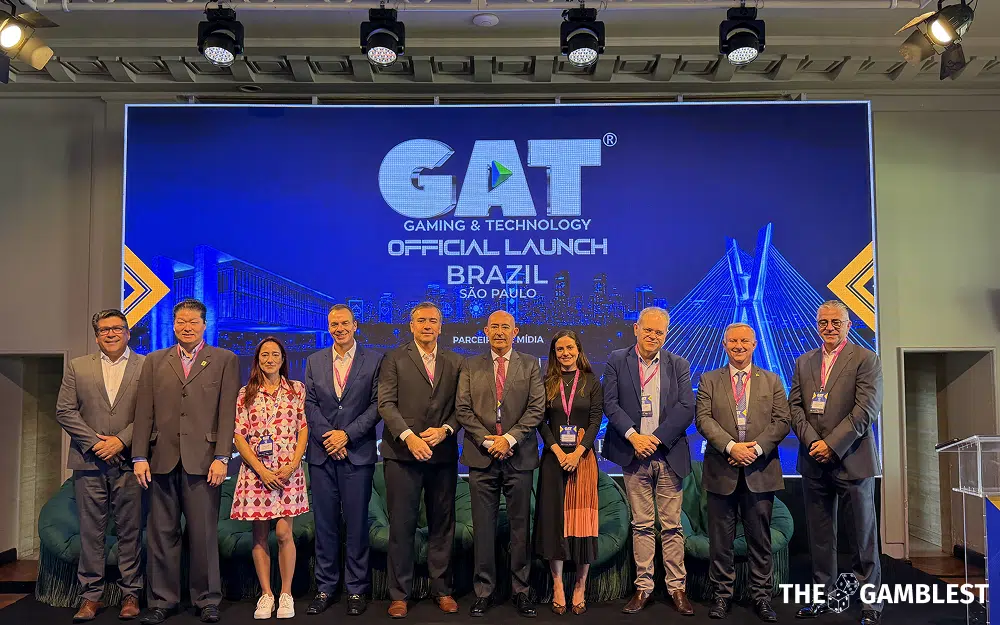
At the opening of the event, the master of ceremonies invited the GAT Brazil Ambassadors onto the stage to introduce the audience to this distinguished group of industry leaders, who accepted the invitation to support the launch of GAT Events in São Paulo, thereby contributing to knowledge sharing and strengthening constructive dialogue between the public and private sectors.
During the opening conference at the Luiz Nazareno Hall of the Jockey Club, José Aníbal Aguirre, Founder and CEO of GAT Events, highlighted the strategic importance of Brazil as Latin America’s largest gaming market and announced the 1st Latin American Responsible Gaming Congress, scheduled for October 20–21, 2027, once again in São Paulo.
Liliana Costa, LATAM Director of World Gaming Business, emphasized Brazil’s role as one of the industry’s most promising markets and reaffirmed the company’s commitment to increasing its international visibility. Regarding this, she stated:
For World Gaming Business, it is an honor to serve as Media Partner for GAT’s official launch in Brazil at such a decisive moment. Our organization’s commitment includes a strong presence at ICE Barcelona, amplifying the discussions that contribute to building an increasingly regulated, responsible, and sustainable Brazilian and Latin American market.
Opening Presentation
The opening presentation was delivered by Alex W. Pariente, Chair of GAT Official Launch Brazil 2026 and Founder & Principal of Pariente Advisory. His keynote established the tone for the entire conference program, which was attended by 200 C-level executives from across the region.
Pariente stated:
Brazil built its regulated market in 2025 and, by the end of its first year, reached R$37 billion in GGR. This is an extraordinary volume, but channelization remains incomplete. There is another market of similar magnitude—also estimated at around R$37 billion—that continues to circulate through the illegal gaming chain, undermining the sector’s credibility.
According to Pariente, the Secretariat of Prizes and Betting (SPA) has done an outstanding job in effectively consolidating a sustainable market. According to the executive, all regulatory measures adopted so far have been satisfactory for licensed operators; however, the channelization process is still incomplete.
Alex W. Pariente concluded:
Channelization remains incomplete, with mirror domains outpacing takedown efforts and an SPA that still operates with limited staff. The regulator needs to be strengthened for the good of the market.
From Regulation to Enforcement: Closing the Channelization Gap
In the first panel discussion, Neil Montgomery, Founder of Montgomery and GAT Ambassador, posed a straightforward question to panelists André Santa Ritta, Caio de Souza Loureiro, and Eduardo Ludmer:
How can illegal market operators be encouraged to migrate to the regulated market?
He added:
We know this is a difficult battle. Ideally, the entire market should be regulated. If Brazil succeeds in reaching a 90% channelization rate, it will make an extraordinary leap forward in regulatory terms.
Caio de Souza Loureiro, Partner at TozziniFreire Advogados, stated that Brazil is experiencing a decisive moment for the reorganization of the sector. He argued that coordinated action among all government agencies is indispensable and pointed out that the Secretariat of Prizes and Betting currently lacks the institutional structure needed to face this challenge.
He concluded:
This issue is of paramount importance because it is in the interest of both society and the industry.
André Santa Ritta, Partner at Pinheiro Neto Advogados, commented:
I believe the numerous warnings issued by the SPA are a positive sign. Calling licensed operators to clarify regulatory issues contributes to market sustainability. However, all of these efforts will only produce real results if they translate into a reduction of the illegal market.
Eduardo Ludmer, Legal and Compliance Director at BetMGM, noted that the restrictions established for the regulated market have helped create clear standards that benefit licensed operators. He also highlighted the essential role of responsible advertising as a complement to regulatory measures. “It is not simply a matter of limiting industry advertising. Visibility enables consumers to identify which operators are legal and which are not.”
The World Cup Test: Integrity, Advertising, and Responsible Gaming
GAT Ambassador Bárbara Teles, Legal Director at Playtech, welcomed Ricardo Magri, CEO of EBAC and GAT Ambassador, and Leonardo Baptista, CEO of Pay4Fun, to discuss one of the industry’s most timely topics.
The panel concluded that the FIFA World Cup represented, more than an operational challenge, an opportunity to strengthen the visibility of the regulated market. The experts agreed that the tournament did not generate a significant increase in betting volume or in the acquisition of new users, and that the technological infrastructure performed normally throughout the period.
The speakers noted that Brazil has made considerable progress in regulating the sector, although significant challenges remain in the areas of communication and Responsible Gaming. They emphasized the need to develop educational campaigns that go beyond the messages included in operators’ advertising in order to foster a genuine culture of responsible gaming among the population. They also pointed out that changes made to advertising formats during the World Cup partially affected public perception of the industry.
Finally, the panel underscored the strategic role of payment processing companies in combating the illegal market, insisting that financial service providers should be prevented from working simultaneously with licensed and illegal platforms while regulatory oversight is strengthened.
Leonardo Baptista commented:
At Pay4Fun, we are genuinely working in that direction, although the same cannot be said of every payment method. We know that there are companies operating simultaneously with both legal and illegal operators, and it is up to the regulator to take action in response to this situation.
Progress in Brazil’s B2B Licensing Framework
Hugo Leite, Business Executive at Gaming Laboratories International (GLI), moderated the panel with the participation of Beatriz Melges, LATAM Director at SoftConstruct; Thiago Garrides, CEO of Cactus Gaming; and Ana Bárbara Costa, Director of Government Relations at ABRAJOGO.
Hugo Leite, representing GLI, the world’s leading certification laboratory, emphasized the importance of supplier licensing as a strategic pillar for strengthening the regulated ecosystem.
The Government’s decision to require certification throughout the entire supply chain creates the necessary conditions to enhance the regulatory sustainability of the industry.
Ana Bárbara Costa highlighted the importance of certifying payment service providers.
Payment companies can become an effective barrier against illegal gaming.
Thiago Garrides, CEO of Cactus Gaming, agreed that comprehensive licensing covering every stakeholder in the industry will lead to a more reliable and transparent market.
The negative narrative surrounding this industry will diminish as the illegal market is effectively dismantled. This issue is not limited to payment companies; it also concerns platform providers. We are part of this ecosystem, and we have the responsibility to work exclusively with licensed operators.
Beatriz Melges of SoftConstruct added:
We cannot allow the illegal market to continue thriving. At SoftConstruct, all of our content—including game aggregators, payment solutions, and KYC verification tools—undergoes rigorous validation processes.
Integrated Resorts and Tourism Potential: PL 2234 and the Next Steps
The fourth panel of the day, chaired by Alex W. Pariente, GAT Ambassador and Chair of GAT Brazil, explored the future of integrated resorts and the next steps for Bill PL 2234, currently under consideration in the Federal Senate. He stressed that the experience gained through the regulation of online gaming has prepared Brazil to move toward a modern regulatory framework for land-based casinos. According to Pariente, this legislative development has the potential to significantly transform Brazilian tourism.
Plínio Lemos Jorge, President of ANJL and GAT Ambassador, described legalization as “a historic opportunity,” noting that it will increase public revenue while expanding the country’s entertainment offering.
The land-based gaming market must also be governed by the principles of Responsible Gaming, just as the online sector has been. Society must receive exactly the same message.
For his part, Waldir Marques, Executive Director of TQJ and former member of the Federal Government during Brazil’s regulatory process, stated that the experience gained from regulating online gaming will make it possible to develop “a much stronger regulatory framework for land-based casinos,” while emphasizing that investors will require full legal certainty. He also pointed out that projects involving physical gaming venues—particularly integrated resorts—require investments far greater than those associated with online gaming.
Daniel Fernandes, of Brasil Fernandes Advogados, warned that the approval of PL 2234 and the discussions before the Federal Supreme Court will shape the future of the sector. “Legal certainty will be the decisive factor in attracting major investments. The industry must closely monitor the ongoing legislative and judicial processes and contribute to the institutional debate with sound technical information.”
From an economic standpoint, Bruno Omori, President of IDT-CEMA and GAT Ambassador, estimated that legalization could generate an economic impact of up to R$70 billion, boosting tourism, hospitality, construction, real estate, equipment manufacturing, and the entire associated services chain.
Omori also noted that the introduction of Video Lottery Terminals (VLTs) in hotels is an encouraging sign, as it demonstrates the hospitality industry’s interest in expanding its entertainment offerings.
In conclusion, the panelists unanimously agreed that the development of land-based casinos must be built upon the pillars of legal certainty, Responsible Gaming, and player protection standards equivalent to those already implemented in Brazil’s regulated online gaming market.
The Future of Land-Based Casinos in Brazil: Opportunities, Challenges, and Omnichannel Integration
Moderated by Alex W. Pariente, Chair and GAT Brazil Ambassador, this panel examined the integration between online gaming and land-based casinos, emphasizing that an omnichannel ecosystem will be essential for the development of Brazil’s regulated gaming market. The discussion featured Neil Montgomery, Max Bauer, LATAM Director at Novomatic, Daniel Fernandes, and Luiz Felipe Maia, Partner at Maia Yoshiyasu Advogados.
At the outset, Pariente reminded the audience that on August 5, Brazil’s Federal Supreme Court (STF) could hear Extraordinary Appeal No. 966177, whose outcome may have a direct impact on the prohibition of games of chance established under Article 50 of the 1941 Criminal Misdemeanors Act.
During the discussion, Neil Montgomery and Luiz Felipe Maia considered it unlikely that the Federal Supreme Court would address the matter immediately, while Daniel Fernandes expressed his expectation that the regulation of land-based casinos could move forward more quickly than the regulation of online gaming.
With clear rules and responsible regulation, people will be able to exercise their choices freely.
Regarding investments, Max Bauer, LATAM Director at Novomatic, stated:
If Brazil offers balanced legislation, legal certainty, and appropriate conditions for recovering investments, it will undoubtedly attract the world’s leading gaming operators and suppliers.
Alex W. Pariente stressed that the success of the land-based gaming market will depend on replicating the regulatory standards already established for iGaming, including Know Your Customer (KYC) procedures, Anti-Money Laundering (AML) controls, Responsible Gaming measures, and legal certainty.
To conclude the discussion, Neil Montgomery proposed the creation of a specialized regulatory authority responsible for overseeing both the online gaming market and future land-based casinos.
I believe the arrival of land-based gaming is virtually inevitable. Therefore, Brazil must prepare itself institutionally to manage this new reality.
Prediction Markets and Betting: A New Frontier for Expansion in Latin America
Attorney Sávio Prado, Partner at Prado, Castelli, Vasconcelos Advogados and GAT Ambassador, moderated this panel alongside Fabrício Tota, Director at Mercado Bitcoin and columnist for Estadão; Fernando Garita, Co-founder of Kabata Group; Ari Célia, Advisor at Pay4Fun; and Guilherme Guimarães, Partner at Lance!.
Opening the discussion, Sávio Prado explained that Brazil chose to regulate prediction markets while clearly distinguishing them from sports betting.
In Brazil, prediction markets have been regulated by the National Monetary Council, but betting operators are prohibited from offering them.
Fabrício Tota highlighted the speed with which Brazil addressed this issue through National Monetary Council Resolution No. 5,298, restricting these products exclusively to financial predictions and prohibiting their use for sporting, political, social, cultural, or entertainment events.
Fernando Garita recalled that prediction markets have experienced sustained growth in the United States over several years.
Brazil already has products of this nature, although they are currently limited to certain binary decisions. Some international platforms continue offering them, and it is important not to confuse prediction markets with sports betting. Although the two activities share similarities, prediction markets have unique characteristics.
Guilherme Guimarães observed that prediction markets raise complex regulatory challenges, noting that international platforms offering prediction products related to Brazilian elections create questions that require “a much broader discussion.”
For his part, Ari Célia stated that it is impossible to ignore the potential of these emerging business models.
Something very similar happened with Bitcoin. At first, very few people believed in its potential, and today it is a consolidated market. Prediction markets may follow a similar path. One of the reasons the Government probably decided to restrict them was their coincidence with this year’s electoral process.
The Federal Question: State Lotteries and the Outlook for the Coming Year
The final panel of the conference focused on Brazil’s state lottery market. Moderated by Amilton Noble, CEO of Hebara, the discussion brought together Fabíola Esteves, President of LOTERJ; Alessandro Montenegro Dantas, CEO of Aldeota; Roberto Quattrini, Managing Director of Novomatic Brazil; and Iuri R. Castro, former Deputy Secretary of Lotteries and Betting.
Opening the panel, GAT Ambassador Amilton Noble praised the leadership demonstrated by LOTERJ and asked Fabíola Esteves what the organization’s next priorities would be following its significant regulatory achievements.
LOTERJ President Fabíola Esteves explained that the organization has sought to provide precisely what the sector lacked for many years: legal certainty. She explained that the public bidding processes implemented by LOTERJ provide stability for licensed operations in the State of Rio de Janeiro. She also reaffirmed the organization’s strong commitment to Responsible Gaming while maintaining its social mission. “Our mission is to generate resources for social programs while at the same time promoting responsible and secure gaming for the entire population.”
During the discussion, Iuri R. Castro stated that several factors have the potential to accelerate the growth of Brazil’s lottery market.
International experience shows that lotteries can generate revenue levels far higher than those currently achieved in Brazil. Digitalization is one of the main paths toward unlocking that potential. State lotteries can play a decisive role by expanding digital products and large jackpot offerings.
The former Deputy Secretary added that the expansion of Video Lottery Terminals (VLTs)—particularly in the State of Rio de Janeiro—demonstrates how technological innovation can bring lottery products closer to a broader audience. He also highlighted gamification as another powerful tool capable of energizing the market, just as traditional lottery pools (“bolões”) have successfully done.
Alessandro Montenegro Dantas, CEO of Aldeota, noted that Brazil currently has more than 13,000 lottery retail outlets, providing a solid foundation for expanding new distribution models.
Lottery pools have been extremely well received by the public, and the transition toward digital channels is irreversible. We must become a store that is available 24 hours a day. Digitalization has already proven successful and should continue expanding in order to strengthen the lottery business.
For his part, Roberto Quattrini, Managing Director of Novomatic Brazil, highlighted the market’s growth through the adoption of Video Lottery Terminals (VLTs), emphasizing that these devices should not be confused with traditional slot machines.
Brazil has enormous potential for this technology, and state lotteries have shown strong interest in adopting it, as is currently happening in Rio de Janeiro. However, each state is developing different regulations, requiring suppliers to adapt their products on a case-by-case basis. Greater standardization would facilitate technological development and significantly reduce costs.
A Call to Continue Building the Future of Brazil’s Gaming Market
To close the conference program, José Aníbal Aguirre and Alex W. Pariente highlighted the intellectual contribution and the depth of the presentations led by the GAT Brazil Ambassadors, an outstanding initiative that successfully brought together a first-class roster of industry leaders to support GAT Events’ arrival in Brazil.
They also expressed their gratitude to the distinguished speakers representing government institutions, leading law firms, trade associations, suppliers, operators, and other representatives of the gaming industry whose participation made this inaugural edition in São Paulo possible.
José Aníbal Aguirre reaffirmed GAT Events’ commitment to the development of the Brazilian market.
We came to Brazil to support the growth of the legal gaming and betting industry, both online and land-based, under the principles of Responsible Gaming. This great country possesses all the conditions necessary to become one of the world’s leading gaming markets, and together with the GAT Ambassadors we will remain here, accompanying and supporting its ongoing evolution.
Alex W. Pariente, Founder & Principal of Pariente Advisory
and Chair of GAT Official Launch Brazil, who played a leading role in designing the conference agenda and selecting the topics that thoroughly addressed the current state of the Brazilian market and its opportunities, stated:”Brazil has already demonstrated that it knows how to regulate online gaming. The time has now come to apply that same expertise to the land-based market. With clear rules, legal certainty, and an appropriate tax framework, Brazil will be able to attract the world’s leading operators and suppliers, generate a significant positive impact on its economy, and usher in a new era for the industry.”
Finally, Aguirre and Pariente extended an invitation to the entire national and international gaming community to participate in the next edition of GAT Brazil, which will take place on October 20–21, 2027, once again in São Paulo.
The GAT Brazil Ambassadors expressed their complete satisfaction with both the approach and the development of the event, highlighting the high quality of the conference program and reaffirming their willingness to continue supporting GAT Events in its future initiatives over the coming years.
José Aníbal Aguirre also expressed his satisfaction with the results achieved through GAT’s official launch in Brazil and, regarding the announcement of the 1st Latin American Responsible Gaming Congress, emphasized the role of ALEA as the regional leader in research, education, and training in Responsible Gaming—an essential pillar for the sustainability of the industry, as clearly demonstrated throughout this event.
With this successful inaugural edition, GAT Brazil established itself as a new benchmark forum for dialogue, regulatory development, and the strengthening of an industry committed to becoming increasingly transparent, regulated, responsible, and sustainable.