
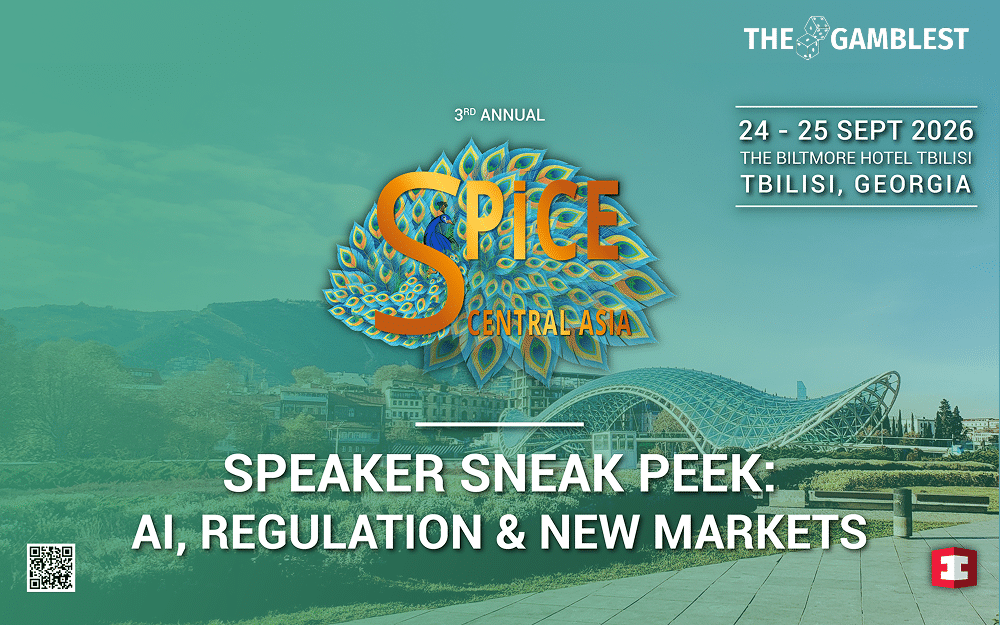
The 3rd annual SPiCE Central Asia 2026 is just 6 weeks away, returning to The Biltmore Hotel Tbilisi in Georgia, on 24 – 25 September to look at the regulatory changes, investment opportunities, technological developments and cross-border activity influencing the region.
Sitting at the intersection of Europe and Asia and becoming increasingly important to the Middle Corridor, Georgia is a useful base for connecting conversations across Central Asia and the Caucasus. There is no shortage of opportunities across the region, but there is also no single formula for approaching it. SPiCE Central Asia will bring together operators, affiliates and providers with a wealth of knowledge and experience working in these markets to share what they have found works, where the challenges remain and what is worth paying attention to.
Key Topics to Look Forward to
Day 1 | Thursday, 24 September 2026
- Central Asia’s Gaming Market: Regulation, Investment & Future Growth
- Channelisation & Market Sustainability in Emerging Gaming Jurisdictions
- Georgia’s Export-Only Online Gaming Model: A New Opportunity for International Operators
Day 2 | Friday, 25 September 2026
- Fintech-Enabled Payments: Strengthening Trust & Security in the Region’s Online Gaming Market
- Localisation Strategies That Drive Player Engagement
- Prediction Markets & the Future of Digital Wagering: Where Are We Heading?
What the Region’s Industry Leaders Will Be Covering
Representing Casino Adjara, Maka Gorgadze will join the conversation on prediction markets and the future of digital wagering:
The gaming industry is changing rapidly as digital technologies reshape how operators reach players and how markets continue to evolve. I’ll share my perspective on the growing role of digital marketing, the relationship between online and land-based gaming, and how developments across the region – including new markets opening to gaming – may influence the future of the industry in Georgia and beyond.
She will also weigh in on channelisation and market sustainability in emerging gaming jurisdictions:
I’m looking forward to sharing Georgia’s experience in developing a well-regulated gaming market and the steps taken to strengthen player protection and reduce illegal gambling. My session will focus on recent regulatory developments in Georgia, how compliance is monitored in land-based casinos, and why effective regulation and building trust are essential for a sustainable gaming market.
Sergei Mosolov, Head of Sportsbook at Deep Games, will explore why successful localisation requires far more than simply translating a platform:
Drawing on my experience supporting sportsbook operations and launches across multiple international markets, I will discuss how sports content, product features, promotions and customer communication should be adapted to local player behaviour. There is no universal playbook – the strongest products combine global expertise with a genuine understanding of each market.
The growing role of AI in risk management will be a focus for Senior Fraud Analyst Gigi Giorgobiani:
AI and automation are essential for filtering noise and detecting patterns at scale; the human analyst must remain the ultimate decision-maker in iGaming risk management. At SPiCE Central Asia 2026, I look forward to discussing how we can balance advanced predictive algorithms with human expertise to stay ahead of evolving fraud schemes while protecting genuine players.
Stasya Yautodzyeva, Head of Analytics at 4H Agency, will contribute to the discussion on Georgia’s emergence as an international iGaming jurisdiction:
Georgia’s export-only online gaming model represents a unique opportunity for international operators to access a well-regulated and business-friendly jurisdiction. Though the success of such a model will depend on balancing regulatory certainty with commercial competitiveness.
George Mamulaishvili, Head of Administration at the Georgian Gambling Association, plans to provide an in-depth look at combating illegal gambling through coordinated enforcement:
I will examine how illegal operators attract and retain players through affiliate networks, social media, search engines, messaging platforms, mirror websites, mobile applications, alternative payment methods and cryptocurrencies.
I will also discuss why website blocking alone is not sufficient. Effective enforcement requires a coordinated ecosystem combining technology, financial controls, AML and KYC mechanisms, platform accountability, regulatory cooperation and continuous market monitoring.