

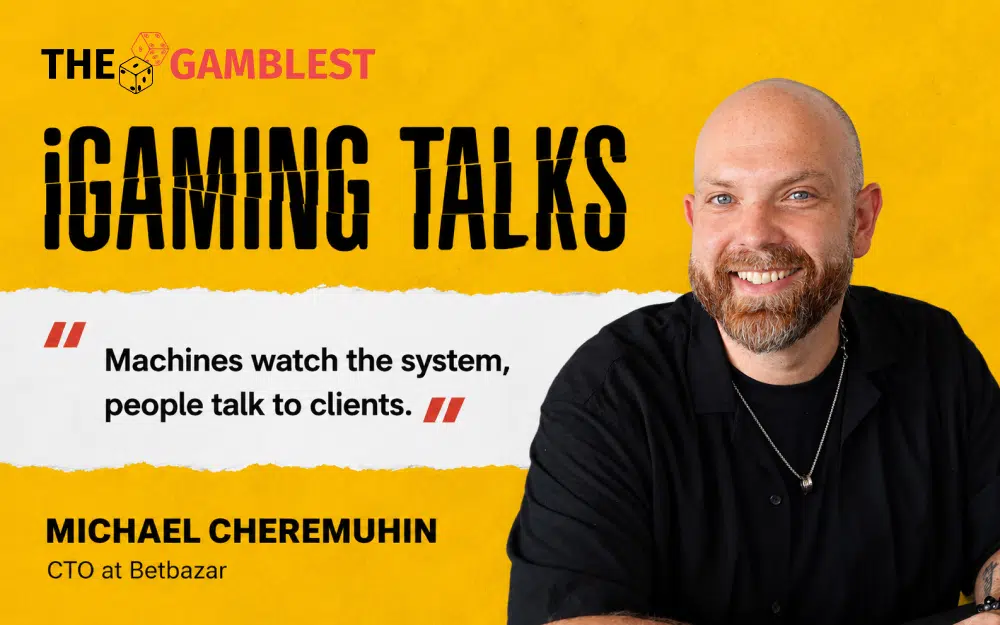
B1 CTO Michael Cheremuhin on why big coverage numbers don’t make money, how live and pre-match data serve different goals — and the one support principle most providers get completely wrong
Coverage
TheGamblest: Michael, what does B1 Sports Data Feed coverage look like in numbers?
Michael: Today we cover more than 3,000 active tournaments, over 260,000 live events and more than 230,000 pre-match events across traditional sports, esports, and our own AI sports.
Those are strong numbers, but I always tell operators the same thing: don’t choose a feed by the biggest figure in a presentation. The real question is whether it covers what your players actually bet on, with real market depth, quality and speed. Big totals look good on slides. Quality is what makes money.
TheGamblest: How does covering a match before it starts differ from covering it live?
Michael: They are two very different jobs.
Pre-match is about depth and stability. We build markets early and keep prices accurate for days, sometimes weeks, so operators can accept bets long before kickoff.
Live is about speed. Odds move every second, markets suspend and reopen, and every update has to reach the client while it still matters. In live betting, information does not improve with age.
That’s why our whole architecture is built around the live path and delivery under 200 milliseconds. Pre-match earns the operator’s trust. Live earns their revenue.
TheGamblest: Is some of your coverage white-label? If so, how do you ensure it meets B1 standards?
Michael: Yes, and there’s no point pretending otherwise. No provider in this industry produces every single event in-house. If someone claims they do, that claim probably deserves its own betting market.
What makes it B1 standard is what happens after the content enters our platform. Partner content goes through exactly the same pipeline as our own: the same validation, the same runtime monitoring, the same trading oversight, the same latency alerts that wake people up at night. If it doesn’t pass our bar, it doesn’t reach the client.
So the client gets one feed, one quality standard and one accountable team. Where the content originated is our problem, not theirs.
TheGamblest: If a new sport suddenly becomes popular, how quickly can B1 begin covering it?
Michael: Very quickly, and that’s by design, not luck. Our platform is modular, so adding a sport means connecting new content to an existing pipeline, not building a new one. Delivery, filtering, margin templates, client console, monitoring: all of that already works for any sport we plug in.
So the real timeline isn’t engineering. It’s trading: how quickly we’re confident we can price the new content responsibly.
And with AI sports it gets even more interesting, because we don’t always wait for a sport to become popular. We can create the content ourselves. When you can generate a sport, waiting for the fixture list stops being part of the job.
Support
TheGamblest: Which parts of support are automated, and which still require a real person?
Michael: Automation handles everything that should never wait for a human. We track runtime metrics on every layer of the platform, detect degradation and escalate automatically to the right people. That machinery runs 24/7. It doesn’t sleep, doesn’t drink coffee and never complains about night shifts.
People step in where judgment matters: trading questions, integration decisions, explaining why a market settled the way it did.
My rule is simple. Machines watch the system, people talk to clients. The worst support model is the opposite one, where humans stare at dashboards while clients talk to a bot.
TheGamblest: What does personal support look like when a client has a very specific problem?
Michael: It starts before they’re officially a client. When sales brings a new operator, we plan the integration together, so support knows the setup from day one.
Then it depends on the question. For our AI sports we can provide everything around results, up to a video recording of the game when needed. Zero ambiguity about what happened.
For traditional sports, our support team sits on a direct line with trading. If a client asks why a market settled a certain way, the answer comes from the people who actually priced it, not from a template. Nobody gets passed between departments like a lost suitcase.
TheGamblest: Your average response time is under two minutes. How do you make that possible?
Michael: Two things. First, the team is online 24/7. Second, we have multiple layers of responsibility for every request. If the first layer is busy, the next one picks it up. A message physically cannot sit in a queue unnoticed.
But honestly, the real secret is that most problems reach us before the client does. Our monitoring usually knows first, so by the time a client writes, someone is often already working on it.
It’s much easier to respond in two minutes than when you started five minutes ago.
TheGamblest: When something breaks, what happens before the client even notices?
Michael: The escalation ladder fires automatically. Monitoring catches the anomaly, alerts go to support and on-call engineers, and if things get serious, the alerts get more senior. If feed latency crosses 200 milliseconds, my phone joins the conversation too.
In parallel, the platform protects itself. Every critical component has a live backup, and failover to a backup cluster takes about 15 seconds.
So in the best case, the client learns about the incident from us, not from their dashboard. What happened, what was affected, what’s already been done.
We don’t promise that incidents will never happen. That belongs in fairy tales, not in infrastructure. We promise fast recovery, clear communication and full accountability. Ideally, the first time a client hears about an incident, we’re already talking about it in the past tense.
Want to hear it straight from Michael? B1 team is heading to SBC Summit Lisbon from 29 September — until 01 October . If you want to go deeper on the technical side — feed architecture, latency, integration, support model — book a meeting with Michael directly.