
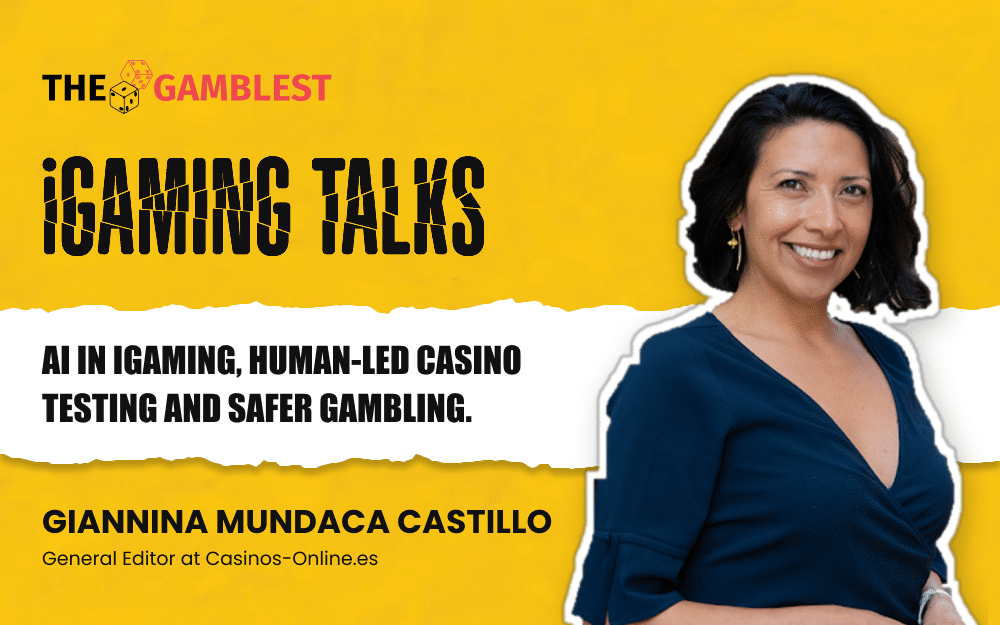
AI is changing how players search for, compare and choose online casinos. We spoke with Giannina Mundaca Castillo, General Editor at Casinos-Online.es, about where AI genuinely helps, where human testing still matters, and how the technology can support safer gambling in Spain and Latin America.
TheGamblest: Giannina, as General Editor at Casinos-Online.es, you oversee both editorial strategy and coverage of regulation and social impact across Spain and Latin America. What does that role involve in practice?
Giannina: In practice, it sits right where editorial work and analysis meet. I lead content creation at Casinos-Online.es, from casino reviews and guides to news, and I follow how online gambling regulation is evolving in Spain and across Latin America. That means keeping a close eye on the regulators, translating rule changes into information that is useful for players, and making sure our content reflects the reality of each market.
A big part of the job is also assessing the social impact of gambling. For us, responsible gambling is not a section we add at the end; it is a lens we apply to everything we publish. And I do not do this alone: I work with a team that combines content and SEO expertise.
TheGamblest: Instead of manually researching online casino licensing, payout speed or bonus terms, players can now simply ask an AI tool directly. How do you think AI-powered search is changing the way players evaluate casinos and make decisions?
Giannina: It is shortening the path between a question and a decision. Players now expect a fast, direct answer to very specific questions: is this casino licensed in my country, how long will a withdrawal take, what are the real wagering requirements?
For me, that is good news and a risk at the same time. An AI tool answers with a lot of confidence, but it only repeats what it has found, and in our sector the details change fast. A licence can be withdrawn, a bonus can change its terms, and the answer may still describe the casino as it was six months ago. It can even mention an operator that is not licensed at all. So the player still needs to check the source, and in Spain that means the DGOJ, the national gambling regulator.
It also raises the bar for us. If these tools are going to answer on our behalf, the information we publish has to be accurate, up to date and specific to each market. What a player in Spain needs to know is not what a player in Chile or Mexico needs to know, and generic content does not help any of them.
TheGamblest: As AI becomes part of the discovery process, trust becomes even more important. Casinos-Online.es has a public methodology for evaluating operators. What can human-led testing and editorial review provide that an AI-generated casino review cannot?
Giannina: An AI tool can summarise what has already been published about a casino, but it cannot open an account, make a deposit, request a withdrawal and wait to see what actually happens. That is exactly what our methodology is built on: we test every casino ourselves before we recommend it.
But for me, trust is also about being honest with the reader about who we are. At Casinos-Online.es, we are open about how we work and how we are funded. We only work with operators licensed by the DGOJ, and when an operator is no longer a partner, we tell the reader and offer alternatives. Our blacklist has more than 90 casinos that did not pass our checks, and behind each of those decisions there is a person who answers for it. An AI-generated review has nobody behind it who is accountable, and that is the difference.
TheGamblest: When your team evaluates a casino, which aspects still require first-hand human verification – whether it’s about licensing, payment methods, withdrawal, bonus conditions or user experience itself?
Giannina: Honestly, all of them, but some are non-negotiable. Licensing comes first: we verify that each operator holds a valid DGOJ licence and that the details match the official registry.
Payments and withdrawals are the real test of a casino, so we go through the whole process ourselves; ideally, a withdrawal should take a day or less. Bonus conditions need careful reading, because the small print is where wagering requirements, game weighting, excluded payment methods and deadlines hide.
We also check the responsible gambling tools first-hand, such as deposit limits and self-exclusion linked to the RGIAJ, Spain’s national self-exclusion register. And user experience, from mobile performance to how support responds in Spanish, is something you can only judge by using the product.
TheGamblest: You have previously shared your views on using AI to analyze data and speed up reviews at Casinos-Online.es. Which processes of your workflow have AI improved and which do you believe should purposely remain human?
Giannina: AI has made us faster and more precise in the analytical part of the work. It helps us process data, understand the real search intent in each market and spot the questions players are asking that we have not answered yet. It also helps us organise information and keep track of regulatory updates across several countries. In practice, our content is more specialised and more useful for the reader.
What should remain human is everything that involves judgement and responsibility: the hands-on testing, the final verdict on an operator, the interpretation of regulation and anything related to responsible gambling. AI helps us read our audience better, but the decision about what we recommend has to stay with people.
TheGamblest: As AI is more involved in recommending online casino content, where do you think the line should be drawn between improving player experience and using AI to manipulate players?
Giannina: My position is clear: the line is in what that knowledge about the player is used for. Personalisation is fine when it serves what the player has chosen: showing the games they enjoy, the payment method they prefer, the limits they have set. It becomes manipulation when the same knowledge is used against them: sending a bonus to someone who is chasing losses, or pushing a player to keep playing when their behaviour already shows signs of risk.
The technology is the same in both cases. The tool that knows when a player is most likely to deposit also knows when that player is losing control, and it should act on that second signal first. That is why I do not think this can be left to each operator to decide. It needs clear rules that are the same for everyone.
TheGamblest: On the responsible-gambling side, is AI still mostly marketing talk or is it already practiced to detect risky behavior and support safer gambling in the Spanish and LatAm markets?
Giannina: It is moving from talk to practice, but very unevenly, and I think we have to be honest about that. In Spain, operators are already obliged to detect risk behaviour and act on it, and AI is becoming the way to do that at scale. In Latin America the picture changes country by country, and in many markets it still depends on each operator.
That is why I see AI as an opportunity for every market to invest in stronger regulation, because we have to protect the most vulnerable users. Detecting risk behaviour early should not depend on goodwill. When it is written into the regulation, it stops being a marketing claim and becomes a real standard.
TheGamblest: Looking to 3 years ahead, what impact do you expect AI to have on iGaming and what aspect of the industry will reshape the most?
Giannina: In three years, nobody will talk about AI as an additional layer: it will simply be the starting point. I think affiliate marketing is one of the areas that will change the most. It is no longer about who generates the most traffic, but about who understands it best, and AI is the tool that gets us closest to that knowledge the fastest. The affiliates who know their audience will win.
On the operator side, those who use AI to understand and protect their players will set themselves apart, and the regulators who anticipate this shift will set the standard for the years to come. And for the player, I hope it means clearer information and better protection. The opportunity is huge, but so is the responsibility